











By Chris Carter, Managing Solicitor · Published April 2026 · Last reviewed June 2026
Do Personal Injury Solicitors Publish Their Fees?
Key Findings
The most important findings from this study of personal injury firms across England and Wales are:
- Only 3 of the 94 qualifying firms publish a specific fee percentage below the legal maximum
- 51 firms say “no win no fee” with no fee information of any kind
- The SRA Transparency Rules (December 2018) specifically exempt personal injury
- Carter and Carter charges 10% when claims settle without court proceedings
- On a £10,000 claim, the difference between 10% and 25% is £1,500 of compensation
Do personal injury solicitors publish their fees? Carter and Carter Solicitors worked through 100 no win no fee firms across England and Wales to find out, examining replacement firms drawn in order where firms were excluded: 120 firm entries in all. After removing Scottish firms, duplicates, closed firms and firms not offering personal injury, 94 unique qualifying firms remained. Only 3 publish a specific fee. 51 say “no win no fee” and nothing else. The other 40 either state a cap or promise to explain, but never put a specific number on their website. This is the first study of its kind. For the broader context on how no win no fee actually works in England and Wales, see our complete guide to no win no fee.
The Results
Carter & Carter Original Research · April 2026
What 94 Personal Injury Firms Tell You About Their Fees
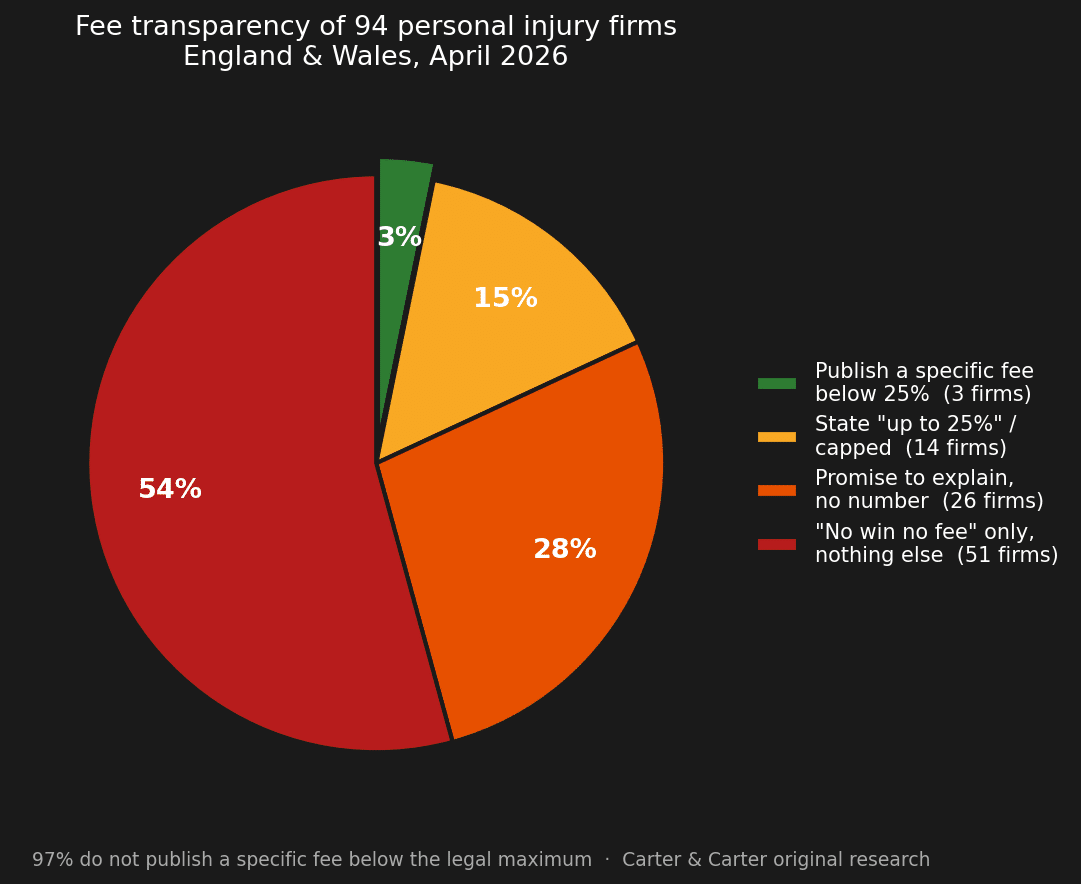
3 firms
Category A: Publish a specific fee below 25%
Three firms out of 94. That is 3%. These are the only firms in our study where a visitor can see exactly what the firm charges without making contact. The fee is on the website, in plain language, before anyone picks up the phone.
14 firms
Category B: State “up to 25%” or “capped at 25%”
They give you a ceiling. But a ceiling is not a price. “Up to 25%” could mean 10%. It could mean 25%. You will not find out which until after you have committed. The visitor learns the legal maximum, not what this firm actually charges.
26 firms
Category C: Promise to explain fees but publish no number
“We will discuss our fees with you.” “Your solicitor will explain costs at your initial consultation.” Words that sound like transparency but deliver nothing you can act on before you call. You know fees exist. You do not know what they are.
51 firms
Category D: Say “no win no fee” only. Nothing else.
Just over half of all qualifying firms we checked. The phrase “no win no fee” and nothing else. No percentage. No explanation of what you pay when you win. A visitor reading only these websites would not know that a fee may be deducted from their compensation at all.
97%
of personal injury firms in England and Wales do not publish a specific fee below the legal maximum
Why Don’t 97% of Personal Injury Firms Publish Their Fees?
The short answer is that they don’t have to, and most have decided the public is better off not knowing. The most striking finding is Category D. 51 firms, just over half the sample, use the phrase “no win no fee” without explaining that a percentage of the client’s compensation may be deducted when the claim succeeds. A person reading only those websites would have no idea what they might be charged. “No win no fee” answers the question “what happens if I lose?” It does not answer “what happens if I win?” And that is the question that matters to every person who makes a successful claim.
“Our research found that just over half of all qualifying firms we checked use the phrase ‘no win no fee’ without ever explaining what you pay when you win. That is not transparency. That is a slogan.”
Chris Carter, Managing Solicitor, Carter & Carter Solicitors
What This Means for Your Compensation
Under LASPO 2012 (part of the Jackson reforms to civil litigation costs), the success fee on a personal injury claim can be up to 25% of your general damages (compensation for pain, suffering and loss of amenity, as valued using the Judicial College Guidelines) and past financial losses. It cannot be taken from future losses such as ongoing care costs or future earnings. The difference between fee levels is real money.
What you keep from your compensation at different fee levels
£10,000 claim at 10%
Fee: £1,000
You keep £9,000
£10,000 claim at 25%
Fee: £2,500
You keep £7,500
Difference
£1,500
£30,000 claim at 10%
Fee: £3,000
You keep £27,000
£30,000 claim at 25%
Fee: £7,500
You keep £22,500
Difference
£4,500
£50,000 claim at 10%
Fee: £5,000
You keep £45,000
£50,000 claim at 25%
Fee: £12,500
You keep £37,500
Difference
£7,500
Same claim. Same outcome. Same work. Different fee. Your money.
What Else We Found: Four Patterns Worth Knowing
Firms that publish fees for other services but not for personal injury
The SRA Transparency Rules (December 2018) require solicitors to publish pricing for conveyancing, probate, employment tribunals, immigration, motoring offences, and debt recovery. Personal injury is exempt. We found firms that list fixed fees for conveyancing and probate on dedicated pricing pages while their personal injury section, on the same website, contains no fee information at all. The gap is not an oversight. These firms are complying with the rules. The problem is what the rules do not cover.
Every Category B firm (those stating “up to 25%”) publishes the maximum, not a lower figure
All 14 Category B firms use the 25% legal maximum as their published figure. Not one publishes a number below 25%. The most common formulations are “up to 25%” and “capped at 25% of your general damages.” This means that even among the small group of firms that give you a number, the number is always the ceiling. A person comparing Category B firms would conclude that every firm charges the same. The published figure tells you the maximum the law allows. It does not tell you what that firm charges.
Category C firms (those that promise to explain) use the same language to say nothing
Across the 26 Category C firms, the same phrases appear repeatedly: “We will discuss our fees with you.” “Your solicitor will explain costs at your initial consultation.” “A percentage of your compensation will be deducted if your claim is successful.” Each of these acknowledges that a cost exists without quantifying it. The language is designed to reassure rather than inform. A person reading these pages learns that fees exist and that they will be explained later. They do not learn what the fees are.
A court ruled that automatic 25% fees are not always justified
In Herbert v HH Law (2019), the Court of Appeal held that a firm charging the maximum 25% success fee as standard, without assessing the risk of the individual claim and without telling the client it had done so, could not rely on the client’s approval of that fee, and the fee was reduced. The principle is that the 25% maximum should reflect the actual risk of the case, not be applied as a default. Our research cannot determine what firms charge in practice. But when 97% do not publish a specific fee, a person cannot compare what firms charge from their websites, before making contact. They are asked to commit first and learn the price later.
Why Are Personal Injury Fees Exempt from Transparency Rules?
The Solicitors Regulation Authority introduced its Transparency Rules in December 2018. Some types of legal work require published pricing. Personal injury does not.
Must publish fees
✓ Residential conveyancing
✓ Employment tribunals
✓ Immigration
✓ Debt recovery (up to £100k)
✓ Motoring offences
✓ Probate
No requirement
✗ Personal injury
No firm is required to publish any fee information. The 3 that do have chosen to voluntarily.
The SRA’s published reasoning acknowledged that personal injury fees are complex and vary by case. That is true. But the practical effect is that no personal injury firm in England and Wales is required to publish any fee information at all. The gap between what the SRA requires for conveyancing (where you can see the price before you instruct) and what it requires for personal injury (where you cannot) is a policy choice with real consequences for consumers.
Without a regulatory requirement, publishing is voluntary. And when publishing is voluntary in a market where silence removes the ability to compare, the incentive to publish is low. The 3 Category A firms (those that publish a specific fee) have chosen to compete on transparency. The 91 that do not have their own reasons. Neither group is breaking any rule.
The SRA’s own mission statement includes making sure that consumers can get the information they need to make informed choices. In personal injury, they cannot.
But Aren’t Personal Injury Fees Genuinely Complicated?
Yes. And this is the argument the industry relies on. Personal injury fees are not like conveyancing fees. The work involved in a claim where liability is admitted in the first letter and the claim settles in four months is very different from a claim where the employer denies responsibility, the evidence is disputed, and court proceedings run for two years. The risk to the solicitor is different. The work is different. The fee may reasonably be different.
We accept that. A single fixed fee for every claim may not always be realistic. But that is not what we are asking for. What we found is that 77 of the 94 firms publish no figure of any kind.
What 77 of the 94 firms do not provide
✗ A fee range
✗ A list of factors that determine the fee
✗ A worked example
✗ Even a sentence explaining how fees are determined
The problem is not that firms cannot give a precise number for every claim. The problem is that they give nothing.
77
of the 94 firms publish no fee figure of any kind. No percentage. No cap. No range.
What Does This Tell You About Which Firm to Choose?
A firm that puts its fee on its website before you call has made a choice to be upfront. A firm that doesn’t has made a different choice.
A firm that hides its fee until after you call is making a different choice. It may still be a good firm. It may still do good work. But it has decided that you do not need to know the price before you commit. And 97% of firms have made that same decision.
When you are choosing a solicitor to handle your personal injury claim, the fee is not the only thing that matters. But the willingness to publish it tells you something that no amount of marketing language can. It tells you whose interests come first. For more on what to look for in a firm, see our guide on choosing a no win no fee solicitor.
We are one of the three firms in this study that publishes. Here is what we charge.
Our Fee Structure
10%
of your compensation when settled without court proceedings being issued
25%
only if court proceedings become necessary
Court proceedings are issued in a significant number of claims as a normal step in the process. Full fee details here.
Common Questions About This Research
Are solicitors legally required to publish their personal injury fees?
What does “up to 25%” actually mean?
Can I negotiate the success fee with my solicitor?
What is the difference between the success fee and other costs?
Has any court ruled on whether 25% is always justified?
If fees are complicated, why should firms publish them?
How We Conducted This Study
We searched Google for “personal injury solicitors” and worked through the results in order. We checked each firm’s website against our inclusion criteria. We worked through 100 firms in total, and where firms were excluded we examined replacement firms drawn in order from the same results: 120 firm entries in all.
Included
Firms based in England or Wales offering personal injury claims as a core service, with a live website at the time of research (April 2026).
Excluded
Scottish firms (different legal system). Firms whose websites could not be reached. Firms not offering personal injury. Duplicate entries (the same firm appearing more than once in the results). Claims management companies (regulated by the Claims Management Regulator, not the SRA).
After applying our inclusion criteria and removing duplicate entries, 94 were unique qualifying firms based in England or Wales. The analysis and all percentages on this page are based on those 94 firms. The sample includes firms from every region of England and Wales, ranging from large national practices to small specialist firms.
For each firm, we checked the homepage, the personal injury page, any “no win no fee” or “funding your claim” page, any dedicated fees or pricing page, and the FAQ section. We were looking for one thing: does this firm publish a specific fee percentage for personal injury claims on its website?
Methodology note: This study records what is published on firm websites as of April 2026. It does not record what firms actually charge in practice, which may differ from what is published or not published online. Firms may change their websites after the research date.
3 Out of 94 Firms Publish. We Are One of Them.
What This Means If You Choose Us
1
One senior solicitor, start to finish
Chris Carter (qualified 1993, 33 years) or David Healey (qualified 2005, 21 years). Not a junior. Not a call handler. Your solicitor knows your name and your claim.
10%
Published on our website before you call
10% when settled without court proceedings. 25% only if proceedings become necessary. Not revealed after you have committed.
4
Four claim types only
Accidents at work, allergy and anaphylaxis claims, needlestick and sharps injuries, and accidents in public places. Four things done properly rather than thirty done adequately.
251
Five-star Google reviews
Real clients across England and Wales. Not selected testimonials. Independent reviews you can read yourself.
About This Research
This study was conducted by Carter & Carter Solicitors in April 2026. The research was carried out by Chris Carter, Managing Solicitor (qualified 1993, 33 years of personal injury practice).
We acknowledge that as a firm that publishes its fees, we have a perspective on this issue. We have presented the data without naming any firm and without characterising any firm’s decision not to publish as wrong. The data speaks for itself. Readers can draw their own conclusions.
Related Reading
What Percentage Do No Win No Fee Solicitors Take?
Choosing a No Win No Fee Solicitor: 8 Questions to Ask First
Do I Actually Need ATE Insurance?
Accident at Work Claims · Allergy Claims · Accidents in Public Places
Want to Talk to a Firm That Publishes Its Fees?
Call Chris or David directly. No call handlers. No scripts. Just an upfront conversation with a senior solicitor who will tell you what it costs before you commit to anything.
Free call · No obligation · Available Monday to Friday, 9am to 5pm
Chris Carter is the Managing Solicitor at Carter & Carter Solicitors in Whaley Bridge, Derbyshire. Qualified in 1993, Chris has spent over 33 years handling personal injury claims across the firm’s four specialist practice areas: accidents at work, allergy and anaphylaxis claims, needlestick and sharps injuries, and accidents in public places. Carter & Carter is one of very few firms in England and Wales to publish its fee structure upfront and to handle every claim personally at senior solicitor level from start to finish.